
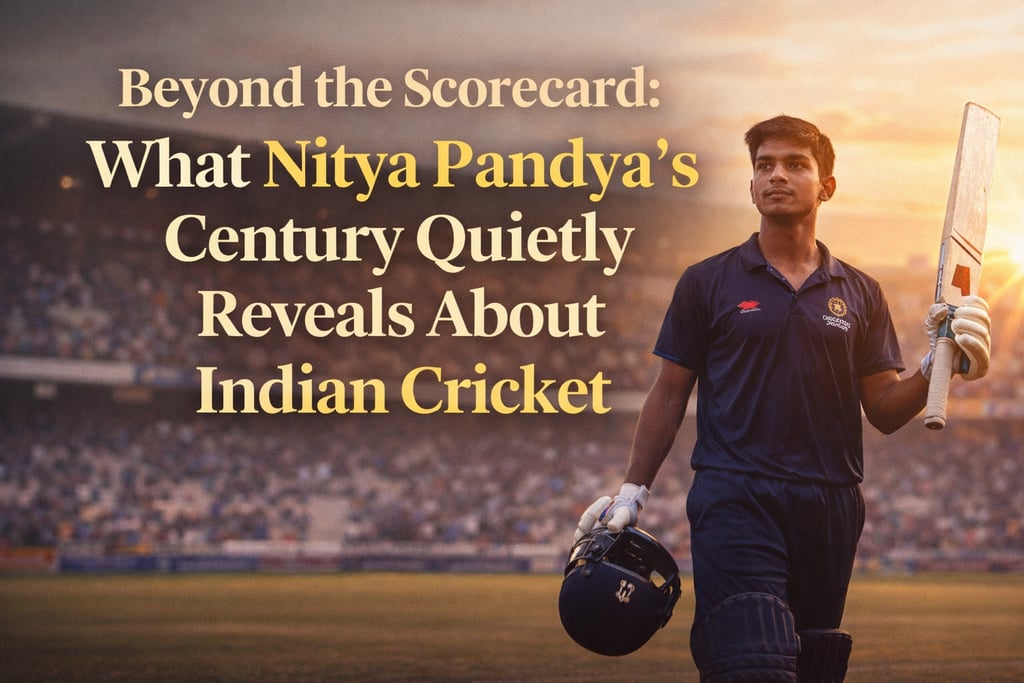
Beyond the Scorecard: What Nitya Pandya’s Century Quietly Reveals About Indian Cricket
A young batter, a domestic ground, and a moment that says more than the numbers ever could.
SPORTSTRENDINGINDIA
12/31/20253 min read
In Indian cricket, centuries happen every day.
They appear on scorecards, scroll past on apps, and dissolve into the endless stream of statistics that define the sport. Most are celebrated briefly and forgotten just as quickly.
But every so often, a hundred arrives that feels… different.
Not louder.
Not flashier.
Just more revealing.
Nitya Pandya’s century in the Vijay Hazare Trophy belongs to that rare category.
The Innings That Asked Us to Look Again
On the surface, there was nothing dramatic about the moment. Baroda were already scoring freely. The pitch was good. The total climbed steadily.
Yet somewhere between run seventy and run one hundred, something changed — not on the field, but in the way people began to pay attention.
Searches spiked. Conversations started. A name unfamiliar to most fans began circulating with curiosity rather than hype.
Who is he?
Where did he come from?
Is this the start of something?
Those questions matter more than the runs themselves.
Domestic Cricket: Where Careers Are Earned, Not Given
International cricket is theatre.
Domestic cricket is apprenticeship.
There are no roaring crowds here, no constant cameras, no instant forgiveness for failure. Just repetition, pressure, and the uncomfortable truth that talent alone is never enough.
For young players like Nitya Pandya, every innings is both an opportunity and a test:
Perform too quietly, and you remain invisible
Fail at the wrong moment, and momentum disappears
Succeed decisively, and doors begin to open
A century in this environment isn’t a celebration — it’s a signal.
A signal to selectors, to analysts, to a system that is always watching but rarely explaining its choices.
Why This Century Resonated Beyond Baroda
Indian cricket fans are accustomed to greatness. They’ve seen legends, prodigies, and icons. But what continues to fascinate them is not just stardom — it’s emergence.
A new name breaking through disrupts familiarity.
Nitya Pandya’s knock didn’t trend because it was flashy.
It trended because it felt like the beginning of a story.
And beginnings, in cricket, are sacred.
The Weight of a First Impression
There is an unspoken truth in Indian domestic cricket:
You don’t get many chances to make a first impression.
This is why such innings linger. Not because they guarantee success — but because they introduce possibility.
From this moment on, Nitya Pandya will no longer walk out unnoticed. His name will appear with expectation. His failures will be remembered, his successes scrutinized.
That is the price — and privilege — of being seen.
The Thin Line Between Recognition and Silence
If this innings had ended at 85, it would have been praised quietly and archived.
At 100+, it became a conversation.
That difference — those fifteen runs — illustrates how fragile visibility can be in Indian cricket.
It is not always fair.
It is rarely patient.
But it is deeply human.
What Happens After the Applause Fades
Centuries do not build careers.
Patterns do.
What follows will define the narrative:
Can he repeat it when conditions are tougher?
Can he contribute when the team needs stability, not dominance?
Can he endure the silence between moments of attention?
These questions will be answered slowly — the only honest way cricket ever answers anything.
A Reminder Hidden in Plain Sight
Nitya Pandya’s century is not a promise of greatness.
It is something far more honest.
It is a reminder that Indian cricket’s future does not announce itself loudly. It arrives quietly, through domestic scorecards, long seasons, and moments when preparation meets opportunity.
Sometimes, all it takes is one innings to remind us where the game truly lives.
Final Note
In a sport obsessed with outcomes, it’s worth pausing to appreciate origins.
Because before every legend, there was a domestic ground, a first century, and a moment when someone noticed — and decided to keep watching.
For Nitya Pandya, that moment may have just arrived.